


Global NOA Software Market For Navigation Will Reach US$2.85 Billion in 2026
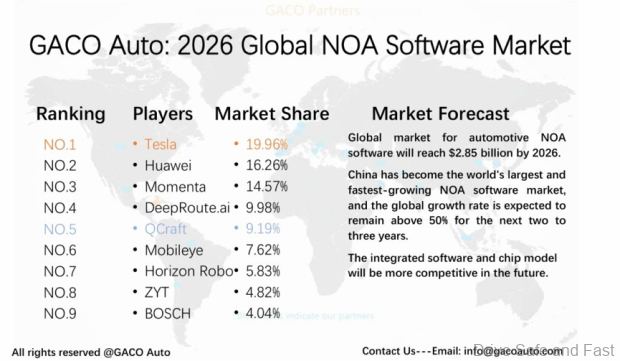
According to a global NOA software market report released by GACO Auto, the global Navigation on Autopilot (NOA) software market is projected to reach USD2.854 billion in 2026, a surge of 90.59% compared to 2025, with growth expected to remain above 50% for the next two to three years.
China has become the world’s largest and fastest-growing NOA software market, followed closely by the United States in second place. A full-blown arms race in autonomous driving, driven by software and AI chips, is unfolding between China and the US.
As an industry pioneer, Tesla is accelerating the commercialization of its Full Self-Driving (FSD) system. Data shows that Tesla’s global FSD paying users increased by nearly 40% year-on-year in 2025, and are expected to exceed 1.5 million in 2026.
On the hardware front, Tesla’s fifth-generation AI chip is in the final design phase, with plans for small-batch trial production in 2026 and mass production in 2027. This chip boasts a computing power of 2000-2500 TOPS, five times that of the existing AI4 chip, enabling it to support more complex unsupervised autonomous driving algorithms.
Meanwhile, the AI6 chip is under development, and Tesla plans to release subsequent AI7 to AI9 series products to continuously solidify its computing power advantage.
Regarding commercial testing, Tesla has deployed over 500 Robotaxi vehicles in Austin and the San Francisco Bay Area, initiating driverless road tests and paving the way for fully driverless commercialization. Industry observers point out that the vertically integrated model of software and chip integration will become Tesla’s core competitiveness in the next stage.
The Chinese camp is led by Huawei. In 2025, Huawei’s partner brands achieved total sales exceeding 900,000 units, and its technical solutions have partnered with the vast majority of domestic automakers. As of August 2025, the Qiankun Intelligent Driving System has been installed in over 1 million vehicles.
Third-party data shows that in the third quarter of 2025, the intelligent driving usage rate of vehicles equipped with Huawei ADS reached 82%, significantly higher than the industry average. Huawei’s publicly stated goal is to achieve large-scale commercialization of Level 4 autonomous driving in urban areas by 2027.

Chinese autonomous driving startups are collectively entering a period of rapid growth in 2026, with leading companies such as Momenta, Horizon Robo, DeepRoute.ai, and QCraft projected to see growth rates exceeding 200% compared to 2025.
Momenta’s urban NOA solution was deployed in approximately 90,000 vehicles in November 2025, while simultaneously expanding its software licensing and Robotaxi business. Its luxury autonomous taxis, built on the Mercedes-Benz S-Class platform and developed in partnership with Mercedes-Benz and UAE operator Lumo, have already been launched in Abu Dhabi and are planned for operation in 2026 with global roll-out.
DeepRoute.ai’s urban NOA deliveries exceeded 40,000 vehicles in November 2025, with monthly deliveries surpassing 10,000 and 30,000 vehicles in June and September respectively. The company aims to achieve cumulative mass production and delivery of its assisted driving solutions exceeding 1 million vehicles by 2026.
QCraft aims to add over 50 new partner vehicle models by 2026, with almost all models equipped with urban NOA, and achieve mass production and deployment of 3 million intelligent driving systems in vehicles by 2027.
Intensive deliveries and globalization are driving China’s NOA industry from technology verification to large-scale profitability.
Mobileye’s revenue for fiscal year 2025 was USD1.89 billion, a 15% year-on-year increase, and it held USD1.8 billion in cash and cash equivalents at the end of the fiscal year. The company has secured USD24.5 billion in automotive orders over the next eight years, and its EyeQ6H-based surround-view intelligent driving solution is expected to deliver over 19 million units.
Automotive NOA software has moved from a high-end optional feature to a standard feature in new vehicles, and software subscriptions and technology licensing will become the profit pillars for NOA software companies.
From 2026 to 2027, with the gradual commercialization of Level 4 autonomous driving, autonomous driving will transform from a sector within the automotive technology race into a core industry impacting global mobility and urban transportation.
Source link: https://gacoauto.com/global-noa-software-market-will-reach-us2-85-billion-in-2026/

