


The Proton X90 Flagship is the most expensive SUV ever sold by the national car company. How has it aged?
It’s been a while since the Proton X90 was launched, and since then, rivals from Japan and China have emerged to challenge the national carmaker. These include the Innova Zenix and the Chery Tiggo 8 Pro. In 2023, we put these three vehicles to the test and found the X90 to be the best compromise between extremes. It offers practical touches and a good overall balance. While it was the least expensive in our comparison, it’s the most expensive Proton ever sold, with the Flagship variant priced at RM152,800.

Two years later, we’re taking this most expensive version of the X90 out for a second look to see how it’s aged.

In some ways, the core of the Proton X90 is still very solid. Even two years later, we still think the car has some really well-tuned suspension. It also feels more or less like what it costs to buy. The cabin construction is solid with large screens and fluid animations. Design-wise, it blends SUV ruggedness with MPV practicality. It’s still one of the most practical cars in its class in many ways.

Access to the 3rd row is pretty easy and there are large storage areas and cupholders throughout the car, plus air con vents and USB type A and type C ports throughout. These are small things that are sometimes taken for granted when it comes to national products, but not in the X90.

Fuel efficiency was also a major selling point at launch and two years on it’s still really impressive. We had the car for a week and used it to move five family members around town. When we returned the car, the fuel tank would have been empty if it weren’t a hybrid with a small displacement engine.

Instead, we had enough petrol left to maybe go to Klang and back if we wanted to. We also didn’t find the fact of its 3-cylinder nature to be problematic in any practical way. The X90 ran smoothly. The powertrain has a weak point, but it’s not the engine; we’ll discuss this later.

It’s worth noting that the Flagship variant is a very different kind of vehicle compared to the Premium variant we drove before. The presence of a panoramic sunroof elevates the cabin space, but it’s really the seating layout that makes the biggest difference.

The Executive and Premium models have a 7-seater layout with two seats in the front, three in the middle, and two more at the back. The Flagship version swaps out the centre bench for two captain seats.
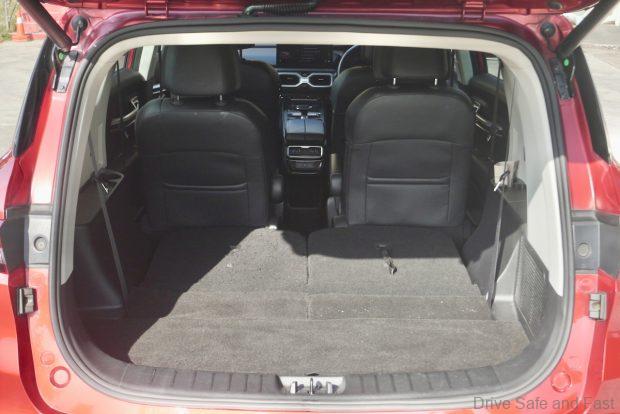
There’s a niche use case for such a seating layout – if you’re used to being chauffeur-driven and want a bit of a pampering experience, a captain seat may be the way to go. However, I think it’s wasted on the X90 because the seats are a little narrower than one might expect. Additionally, if one or both of the rearmost seats need to be folded down for cargo use, the car effectively becomes a 4 or 5-seater.

In our test unit, one seat’s mechanism for unfolding (a strap) had completely failed, so it was permanently down with no backup mechanism to release the seat. This meant I had a permanent 5-seater with a smaller-than-expected boot. Sure, it was still a much better vehicle to drive my family around in than a B-segment sedan, but much of the utility of such a large vehicle was completely lost once a child seat had to be installed.

As hinted at earlier, the dual-clutch transmission remains the largest weakpoint of the Proton X90. During take-off and low-speed maneuvers such as parking, it just doesn’t have a natural pedal feel.

I was also disappointed in the lack of Apple CarPlay and Android Auto. Enough time has passed for Proton to have implemented a running change for the X90, which, again, is the company’s most expensive product ever.

Customers may not care that Proton’s smallest SUV has a 4-cylinder while the largest one has a 3-cylinder, but overlooking such a glaring equipment absence on a car costing significantly more is downright crazy unless the X90 is put on deep discount until a running change can be implemented.

Overall, the Proton X90, two years later, is really starting to show its age. Which is a strange thing to say and we don’t say it lightly. This is a car that Proton should be able to sell in much larger numbers if it just paid attention to the details. If the company had stuck to its original mandate to bring in affordable cars for the masses, we might have gotten a Geely Jiaji-derived vehicle at the price of an Alza, and then maybe the story would have been different.

Many of us would like to see a little competition being brought to Perodua, and an alternative to the Alza would give a lot of Malaysian families a reason to be excited for a Proton on the porch.

Instead, we have an RM150K car being sold by a company that isn’t quite used to selling cars at this price. At this price bracket, attention to detail matters, and ultimately, it’s where the X90 still needs a bit of work. More can be done and we hope we see an update to this model soon that brings it to where it needs to be.

Proton X90 Flagship Specifications
Engine: Inline-3, 12-Valve, DOHC, Hybrid
Capacity: 1477cc
Gearbox: 7-speed Dual Clutch Transmission
Max power: 177 hp @ 5500rpm
Max torque: 255Nm @ 1500rpm
Price: RM152,800

