


A recent vehicle fire involving a BYD Seal on Hong Kong’s Tuen Mun Road has drawn significant attention to electric vehicle safety. However, technical investigations have officially ruled out the car’s internal systems, pointing instead to a common consumer electronic device as the primary ignition source.
On March 3, 2026, at approximately 2:01 p.m., a silver BYD Seal electric sedan caught fire near the Tsing Tin Interchange on Tuen Mun Road. The incident caused immediate concern among onlookers, but thanks to the swift actions of emergency services, the blaze was fully extinguished by 2:19 p.m. Most importantly, the female driver managed to exit the vehicle safely before the fire intensified, resulting in no injuries.
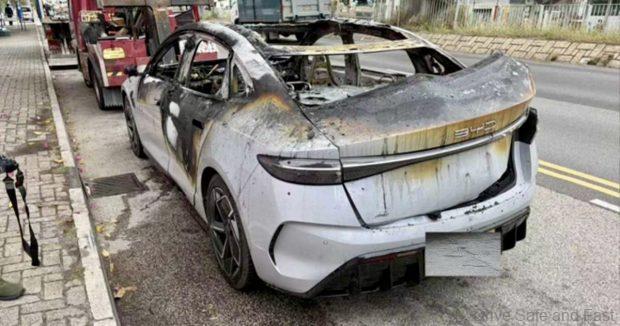
The Investigation: Power Bank, Not Powertrain
Following the incident, the vehicle was moved to a BYD service centre for a thorough technical investigation. Experts confirmed that the fire was not caused by any mechanical or electrical fault inherent to the vehicle’s design.
Instead, the investigation identified a power bank left on the passenger seat as the culprit. The device suffered a short circuit or thermal runaway, which ignited the surrounding cabin materials. BYD has since issued a formal statement clarifying that the vehicle’s high-voltage systems were entirely uninvolved in the initial ignition.
Blade Battery Resilience
One of the most significant findings from the post-fire inspection was the condition of the vehicle’s energy storage system. Despite severe damage to the upper cabin structure—with temperatures high enough to melt interior plastics and glass—the “Blade Battery” pack and integrated chassis remained completely intact.

The battery cells did not undergo thermal runaway, a critical safety win for BYD’s proprietary technology. This resilience is attributed to two main factors:
- LFP Chemistry: The use of Lithium Iron Phosphate (LFP) provides a much higher exothermic threshold (exceeding 500°C) compared to traditional NMC batteries.
- Honeycomb Structure: The battery’s honeycomb aluminium structure acted as a physical thermal barrier, preventing the external cabin fire from breaching the cell compartment.
A Lesson in Cabin Safety
This incident serves as a timely reminder for all motorists—regardless of whether they drive an EV or an ICE vehicle—about the dangers of leaving high-capacity lithium-ion power banks in direct sunlight or on vehicle seats.

The BYD Seal incident demonstrates that while external factors can still pose fire risks, modern EV battery architecture is increasingly capable of isolating these events to prevent catastrophic failures of the primary high-voltage system.
This article is based on reporting by CarNewsChina.

