


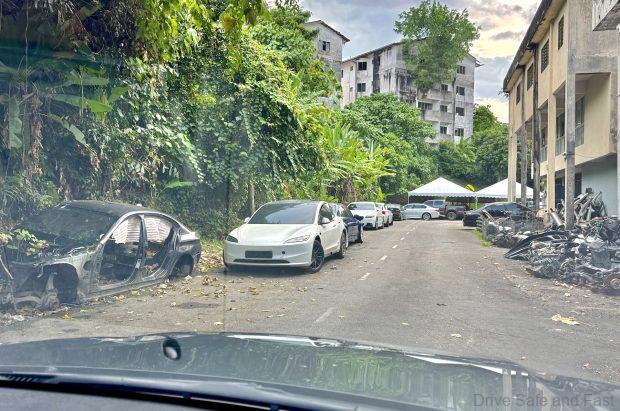
A reader shared this image of a Tesla stranded outside a workshop in an industrial area outside of Klang Valley. It seem, this white Tesla is not the only unit sitting there as there are another 2 units inside and at the side the workshop which does not seem to be authorised to be looking into an electric or even hybrid vehicles.
With the doors left unlocked/open we can assume that the battery system is ‘kaput’ because you need to have battery power to ‘lock’ and ‘unlock’ the Tesla (all electric cars also) doors.
In early, 2020, before Tesla officially arrived in Malaysia, some private importers brought in a number of units from Japan without knowing how to charge, where to maintain and what to do. Priced at RM380k or so some early Malaysian EV adopters bought these Tesla’s and today they might be simple ornaments in their garage or sitting outside workshops waiting for repair solutions.
Today a brand new with warranty and after sales Tesla Model 3 is just RM169,000. Thats a hefty RM211,000 savings!
These used Japanese-imported Teslas often get stranded in workshops due to charging incompatibility, specifically the lack of native CCS2 or CHAdeMO port support in certain Japanese models, requiring complex, costly, and often unavailable adapter or charging system conversions. These cars frequently arrive with low battery levels and lack standard charging cables, causing immediate functional failures in new, non-Japanese markets.
Why There Are Stranded Japanese Import Teslas In Malaysia
Charging Incompatibility (CCS2/CHAdeMO): Japanese Tesla models often use a different charging standard. Importing them to countries using CCS2 (like Malaysia, Singapore or Australia) requires a specialized, often expensive, CCS2 conversion for the onboard charger to work properly.
Lack of Proper Charging Equipment: These imported electric cars often do not come with the appropriate “granny chargers” or adapters compatible with local power sockets, making it impossible to charge them upon arrival.
Software/System Restrictions: The vehicles are programmed for Japanese charging infrastructure and network connectivity, which may not function correctly in other countries, causing issues.
Battery Health Issues: Some imported electric car units may have been stored for long periods, leading to severely drained or damaged battery packs.
Lack of Specialist Knowledge: Some local workshops may struggle with the specific technical requirements of a Japanese-specification Tesla, making repairs difficult or slow.
For these reasons, importing a used Tesla from Japan can lead to a “dead” car that cannot be charged or driven, requiring specialised knowledge to fix.

