


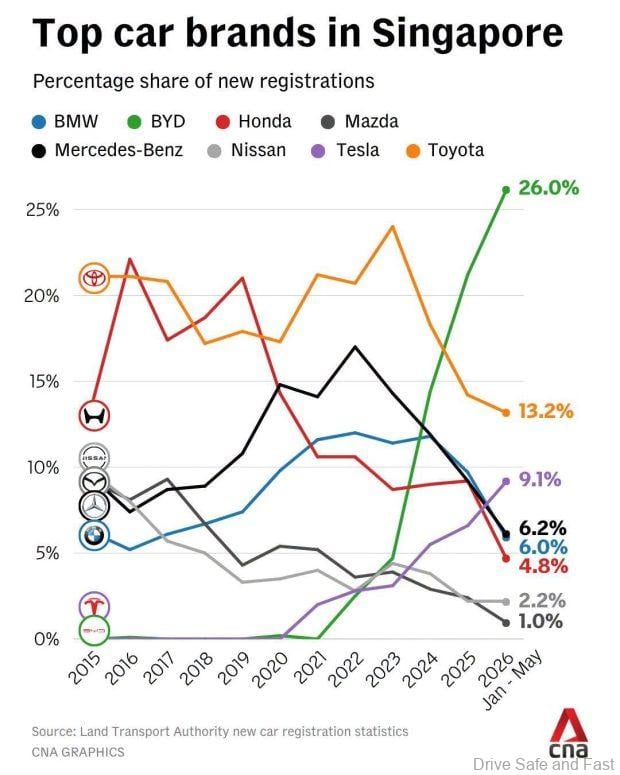
Singapore Land Transport Authority data visualised by Channel News Asia shows an expected trend arising.
The automotive landscape in Singapore is undergoing a massive, unprecedented transformation. For decades, the choice for a typical Singaporean car buyer was predictable, heavily favoring reliable Japanese internal combustion engine (ICE) vehicles or traditional German luxury models. However, recent data from the Land Transport Authority (LTA) displayed in the chart from Channel NewsAsia (CNA) reveals a dramatic, vertical disruption in the percentage share of new vehicle registrations. The taste of Singaporean buyers has officially pivoted toward Chinese electric vehicles (EVs), completely upending the traditional market hierarchy.
The Meteoric Rise of BYD and Tesla
The most shocking takeaway is the meteoric trajectory of Chinese EV manufacturer BYD. BYD experienced an exponential surge after they began selling directly in the passenger car market back in 2019, capturing a staggering 26.0% of all new car registrations between January and May 2026. This places BYD far ahead of any other automotive brand in the country.
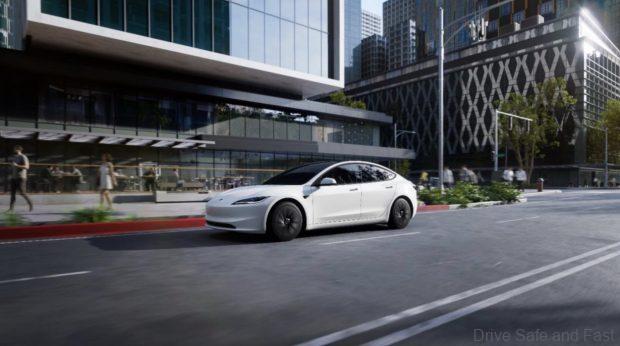
Similarly, Tesla has established a powerful foothold, rising from obscurity in 2020 to command 9.1% of the market in 2026, outperforming legacy premium giants like Mercedes-Benz (6.2%) and BMW (6.0%).
What Is Influencing This Change in Tastes?
This aggressive shift in Singaporean consumer tastes is not accidental; it is driven by a combination of government policy, fiscal incentives, and evolving luxury perceptions:
- Aggressive Green Policy & Infrastructure: The Singaporean government’s commitment to phasing out ICE vehicles by 2040 has structurally adjusted buyer habits. Massive expansions in public and residential charging networks have effectively neutralized range anxiety for urban commuters.
- Fiscal Incentives and COE Class Dynamics: The Vehicular Emissions Scheme (VES) and EV Early Adoption Incentive (EEAI) provide significant tax rebates for zero-emission cars. Crucially, brands like BYD have strategically optimized their powertrains to qualify for Category A Certificate of Entitlement (COE) brackets. In a market where COE premiums frequently hit record highs, the ability to buy a high-tech EV under a lower COE tier has made electric mobility highly cost-effective.
- Technology Over Heritage: The modern Singaporean buyer is highly tech-savvy and environmentally conscious. The minimal running costs, quiet ride comfort, and cutting-edge software suites offered by BYD and Tesla are now viewed as more “premium” and desirable than the heritage engineering of century-old ICE brands.
The Decline of Legacy Giants
As EV adoptions soar, traditional household names are facing a sharp decline. Toyota, which long sat comfortably at the top of the pyramid—peaking at nearly 24% market share in 2023—has plummeted to 13.2% in 2026. The drop is even more severe for Honda, which cratered from a peak of over 21% in 2016 and 2019 to a mere 4.8% share today. Brands like Nissan (2.2%) and Mazda (1.0%) are similarly being pushed to the margins of consumer consciousness.

Ultimately, the chart illustrates that the Singaporean car buyer’s taste has permanently evolved. Status is no longer strictly defined by German luxury badges or Japanese mechanical reliability, but by silent electric powertrains, advanced computing platforms, and sustainable, zero-emission urban mobility. The same may be happening in Malaysia soon, thus MITI’s incentive to keep a high price floor on imported Chinese EVs.

