

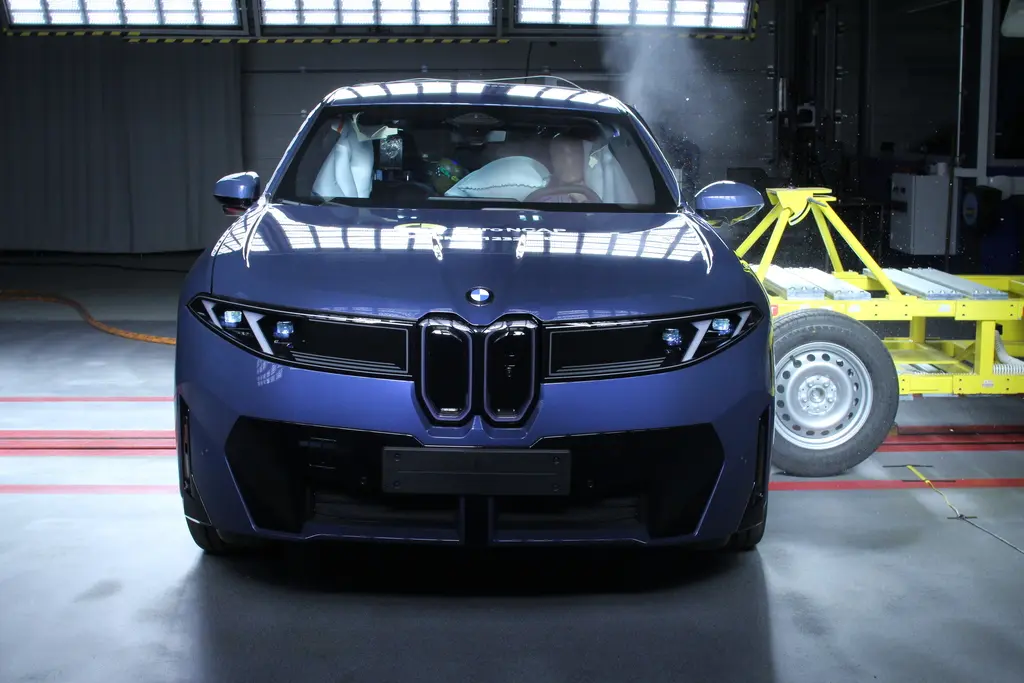
The all-new BMW iX3 has been put through the latest ANCAP safety standards.
The fully electric BMW iX3 (NA5 series) has officially been put to the test under the newly implemented 2026-2028 ANCAP safety rating criteria. Applicable to both the front-wheel-drive 40 and all-wheel-drive 50 xDrive variants rolling out across Australia and New Zealand, the mid-size premium SUV was subjected to an overhauled testing framework.

This updated testing protocol places significantly heavier emphasis on real-world crash avoidance tech, driver monitoring systems, electric vehicle post-collision safety, and vehicle-to-vehicle crash compatibility.

The vehicle’s overall performance was analyzed across the Four Stages of Safety, highlighting where the German automaker excels and where the new, tougher testing criteria exposed room for improvement.

1. Post-Crash Safety: 95%
The absolute strongest performance for the BMW iX3 came in the Post-Crash domain, where it secured a near-perfect score of 95%. Under the new safety protocols, electric vehicle energy management and structural integrity after an accident are heavily scrutinized.

- EV Fire Risk Management: The iX3 demonstrated flawless post-crash battery voltage isolation and highly effective thermal propagation control to prevent fire risks.
- Submergence Safety: In the event of vehicle submergence in water, BMW successfully proved that the electrically operated windows remain functional for the minimum required timeframe to allow occupant escape.
- eCall Infrastructure: The vehicle features an automatic emergency crash notification (eCall) system that actively transmits precise crash telemetry and location data to emergency services, backed by a minimum six-year operational window for owners in Australia and New Zealand.
- Mechanical Fail-Safes: Following all crash testing impacts, the vehicle’s electronic door handles automatically remained extended and operational, while the manual interior door release triggers remained completely functional despite a total loss of 12V electrical power.

2. Crash Protection (Occupant Passive Safety): 86%
The iX3 achieved a highly mature 86% score for passive crash protection, demonstrating robust structural engineering across adult and child occupant safety boundaries.
- Side-Impact Excellence: The SUV achieved maximum points for both adult and child occupants during the side-impact (T-bone) test, alongside a perfect score for the driver in the high-severity oblique side-pole test.
- Far-Side Interaction: Occupant-to-occupant head contact in a side-impact collision was drastically minimized thanks to a standard center airbag deployed between the two front seats.
- The Compatibility Deduction: Where the new 2026 criteria penalized the iX3 was in its vehicle-to-vehicle compatibility. The SUV received a severe -19% deduction because its front structure presents a moderate risk of causing aggressive damage to the occupants of an oncoming vehicle if struck head-on.

3. Crash Avoidance (Active Safety Systems): 83%
In the active safety category, the iX3 logged an 83% score, demonstrating highly capable Autonomous Emergency Braking (AEB) and lane preservation technology.
- Car-to-Car & Vulnerable Road User AEB: The automated braking system scored highly in avoiding same-direction and turning-path collisions with other passenger cars. It also exhibited good stopping performance when detecting pedestrians and cyclists.
- Cyclist Dooring Protection: The vehicle achieved maximum points for its integrated anti-dooring safety feature, which temporarily locks the doors if the radar detects a cyclist approaching the vehicle from behind.
- Sophisticated Lane Keeping: The Emergency Lane Keeping (ELK) framework links directly to the driver’s live attention state. If the system determines the driver is fully aware, it actively reduces annoying or unnecessary steering wheel interventions during overtaking maneuverings.
- System Blind Spots: The active safety suite struggled in crossing-path scenarios involving motorcycles, achieving a weak 16% score. Furthermore, while the AEB system manages low-speed reverse backup avoidance effectively, it lacks the system override capability to stop a forward pedal misapplication toward a pedestrian.

4. Safe Driving (Driver Assistance & Behavior Monitoring): 71%
The lowest, yet still satisfactory, score occurred in the Safe Driving quadrant, where the iX3 scored 71%. This category evaluates how cleanly a vehicle monitors its occupants and interfaces with real-world road environments.
- Rear Seat Occupancy Tracking: 100% (Pass)
- Speed Control Function: 100% (Pass)
- Speed Limit Info Recognition: 85% Accuracy
- Child Presence Detection (CPD): 60% Accuracy
- Passenger Airbag Status Tracking: 50% Accuracy
- Driver Monitoring System (DMS): High Performance (Fatigue/Distraction)
- Front Seatbelt Routing / Misuse: 0% (No Monitoring Control)
- Out-of-Position Front Passenger: 0% (No Structural Tracking)

While the Driver Monitoring System (DMS) performed well in detecting transient driver distraction and fatigue, the vehicle missed out on points because it lacks technology to monitor front seatbelt routing misuse or identify when a front-seat passenger is sitting “out-of-position” (such as resting feet on the dashboard).
Additionally, during real-world Australasian road evaluations, the Speed Limit Information Function successfully mapped out 73% of local speed change events, translating to an effective coverage of 92% of total distance driven.

Summary of the New Criteria Impact
The results confirm that while the BMW iX3 remains an incredibly safe vehicle platform structurally, ANCAP’s tougher 2026 criteria aggressively demand that vehicles protect not just their own occupants, but other road users as well. The iX3’s high post-crash electrical isolation safety and advanced active driver shielding position it as a strong contender in the premium electric SUV landscape.

