


Will Huawei finally not only solve the EV range problem but make EVs better than ICE?
Huawei has recently filed a new patent that signals its growing interest in the EV sector, despite not manufacturing EVs itself. The patent centers around a potentially groundbreaking sulfide-based solid-state battery, which could dramatically outperform current battery technology. Congratulations, Huawei. If they get this off the ground it will be a miracle.
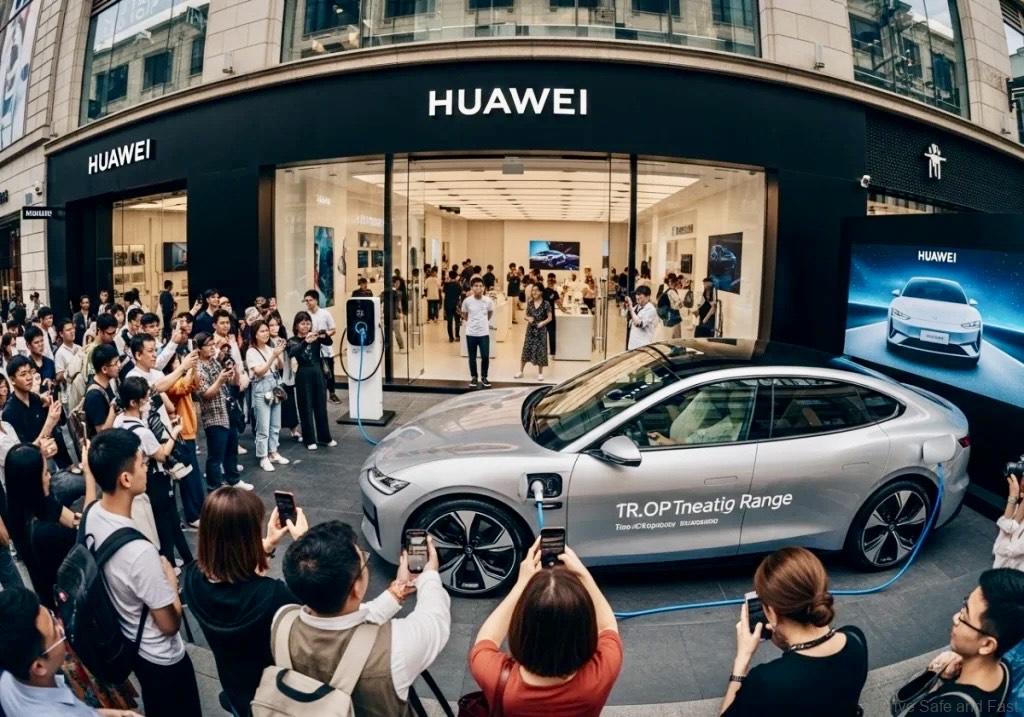
According to the filing, Huawei’s battery could theoretically power an EV for up to 1,864 miles (roughly 2,999.817km) on a single charge, a figure that far exceeds the capabilities of today’s lithium-ion batteries. Moreover, the battery is designed to charge rapidly, jumping from 10 percent to 80 percent in less than five minutes.
Moreover, if realized, these advancements could significantly reduce charging anxiety and revolutionize the EV ownership experience. A key element of this innovation lies in its use of nitrogen-doped sulfide electrolytes. This approach addresses a major challenge in solid-state battery development, minimizing side reactions at the lithium interface, which have historically hindered performance and durability.
Huawei’s design aims to overcome this hurdle, potentially paving the way for more reliable and efficient battery systems. The battery is estimated to deliver energy densities between 180 and 225 watt-hours per pound (Wh/lb), offering a significant improvement over the typical 100 to 150 Wh/lb seen in current lithium-ion batteries.
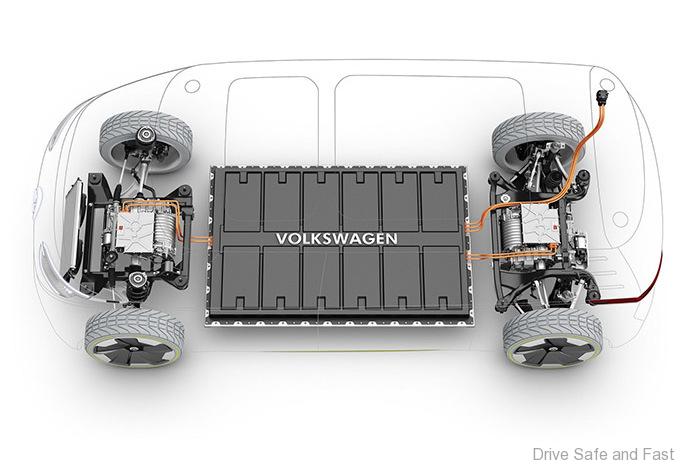
These high energy densities could also lead to lighter battery packs with extended driving ranges. Huawei now joins a growing list of major players, including BMW, Toyota and CATL, who are racing to commercialize solid-state batteries.
On top of that, these next-generation batteries are expected to offer several benefits over current technologies, namely, they are lighter, charge faster, offer greater range and pose fewer safety risks. However, experts note that while Huawei’s claims are exciting, the technology remains in a theoretical stage and has yet to be proven at scale.
Although Huawei does not manufacture EVs, it is actively involved in the automotive industry through partnerships with carmakers, supplying advanced smart systems and technologies. As EV platforms become increasingly integrated with digital and AI-powered systems, Huawei’s involvement could expand, potentially influencing future vehicle architectures.

This patent also reinforces China’s leadership in the global EV battery space. With the country already dominating patent filings in this area, Huawei’s entry into solid-state battery innovation adds another layer of momentum to the rapidly evolving landscape of electric mobility.

