


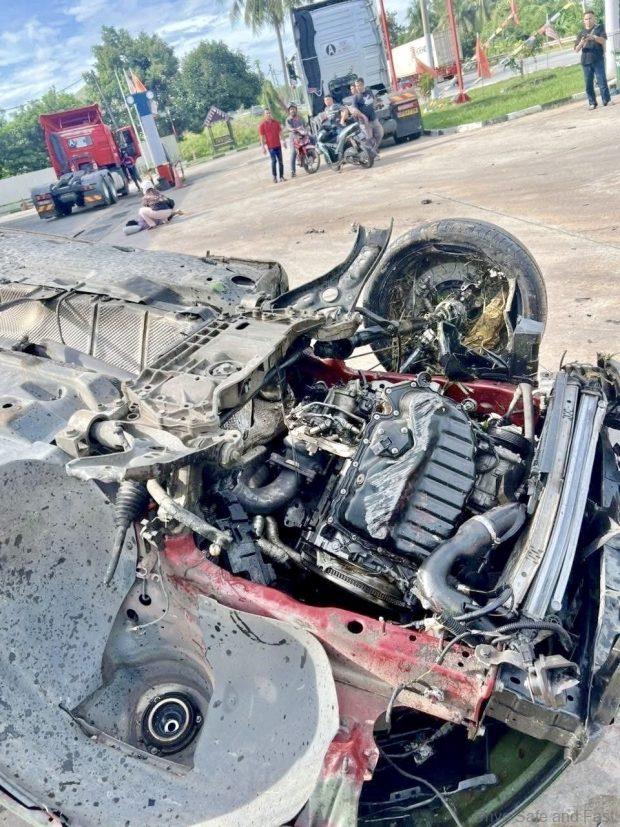
There is a video circulating online showing the driver of this hot hatch hitting the kerb at high speed at flipping over, missing hitting the petrol pump which could have resulted in a massive explosion
Looking at the pictures here, it sure looks like the drive of this GOLF GTI hot hatch was enjoying the power delivery and misjudged the curb location of the Caltex station in Taman Angsana, Changlun, Kedah.
Interesting fact. At high speeds, a car flips due to a combination of high-speed manoeuvres and external factors that cause it to become unstable and lose its grip on the road. This occurs when the forces pushing the car sideways overcome the forces holding it on the road.
The physics of a rollover accident is a battle between these forces acting on a vehicle during a turn or a sudden manoeuvre.

Inertia (centrifugal force) is where the car’s natural tendency to travel in a straight line. During a sharp turn, this force pushes the car horizontally away from the centre of the curve, acting at the vehicle’s centre of gravity.
Tire forces (centripetal force) which is when the friction between the tires and the road provides the opposing force needed to turn the vehicle. This force acts on the tires at ground level.
Gravity must not be forgotten as the downward pull on the vehicle’s weight will also be working.
A rollover happens when the inertial forces, acting high up at the centre of gravity, are powerful enough to overcome the stabilising force of gravity, causing the vehicle to pivot and roll over the tires on the outside of the turn.
The physics of a flip and rollover
Centripetal vs. Centrifugal Force: When a car turns, it experiences an inward-pulling centripetal force from the tires to stay on the curved path. However, its inertia causes a tendency to continue straight, experienced as an outward-pushing centrifugal force.
Momentum and the Centre of Gravity: At high speeds, the centrifugal force increases, creating a tipping force, or moment, around the point where the tires touch the road.
Force Imbalance: A rollover occurs when this outward tipping moment becomes greater than the stabilising moment from gravity, which pulls the car down.
High Centre of Gravity: Vehicles with a higher centre of gravity, like SUVs and trucks, are more prone to rolling because the high position of their mass makes the tipping moment much stronger.
Friction: The friction between the tires and the road provides the necessary centripetal force to turn. When this force is exceeded, the car will slide instead of turning, but if the tipping moment becomes too great first, it will roll over before or instead of sliding.

Common scenarios
Taking a sharp curve at high speed like in this situation perhaps: The high speed results in a large centrifugal force, which can easily cause a rollover if the curve is too tight.
Sudden swerving which is also a possible situation here: A quick, sharp turn to avoid an obstacle can cause a rapid shift in weight and create a large centrifugal force, leading to an “untripped” rollover.
Tire contact with uneven or soft ground: Hitting a steep embankment, a ditch, or even soft soil can provide the “trip” needed to start the rollover motion.

