


PROTON has reaffirmed its commitment to advancing Malaysia’s automotive manufacturing landscape during a high-level working visit by the Ministry of Investment, Trade and Industry (MITI) to its Tanjung Malim production complex.
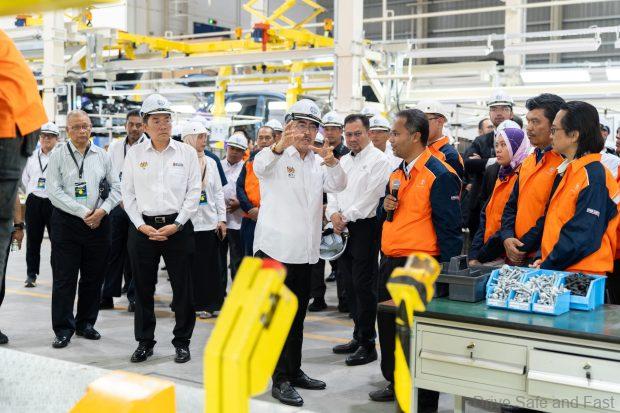
Led by MITI Minister Datuk Seri Johari Abdul Ghani and Deputy Minister Sim Tze Tzin, the delegation was briefed on PROTON’s long-term business direction, including strategic initiatives utilizing its Advanced Modular Architecture (AMA) platform which currently underpins the Saga.
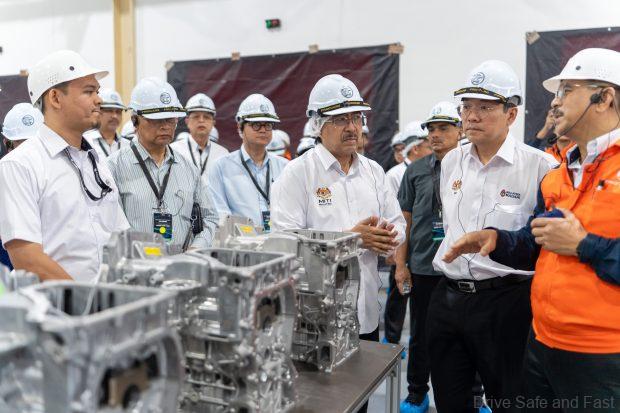
The visit was highlighted by the official commencement of local production for Dedicated Hybrid Transmissions (DHT) and Electric Drive Units (EDU) at PROTON’s Powertrain Plant.
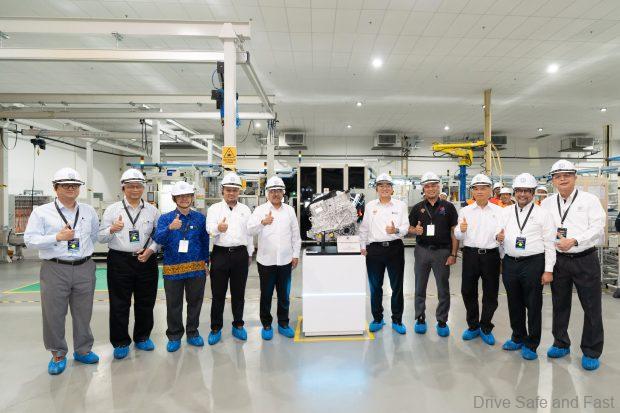
Malaysia’s First Local DHT and EDU Assembly Line
The initiative makes PROTON the first automotive OEM in Malaysia to locally manufacture both DHTs and EDUs—critical core components for electrified vehicles (xEV).
• Facility Investment: RM 121 million Powertrain Plant expansion.
• Local Vendor Participation: 8 out of the 16 supporting component suppliers are local Malaysian companies.
• Key Beneficiary: Increases local content localization for the locally assembled (CKD) Proton e.MAS 7 PHEV.
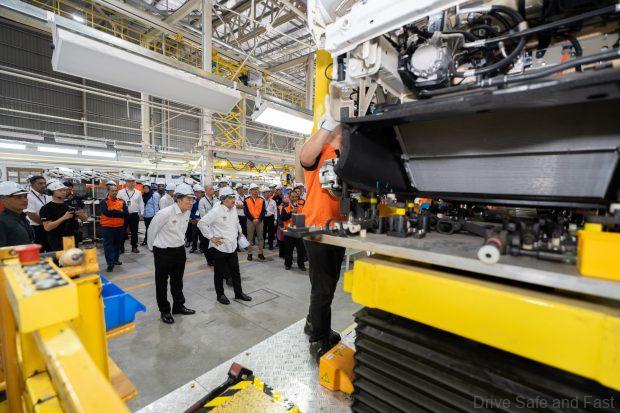
The localized production footprint directly aligns with MITI’s target of reducing the national trade deficit by encouraging foreign and local original equipment manufacturers (OEMs) to source high-value vehicle components within Malaysia.
This news follows the start of local assembly of the e.MAS 7 PHEV, which is the first plug-in hybrid electric vehicle to be locally-assembled in Tanjung Malim by Proton.
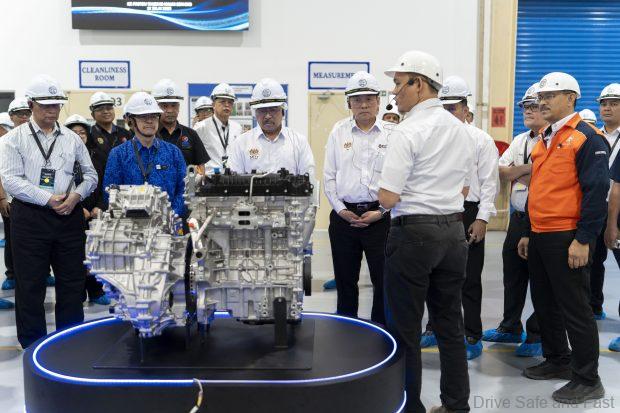
Ministerial Commentary and Economic Impact
During the facility tour, Minister Datuk Seri Johari Abdul Ghani praised the progression of PROTON’s partnership with Zhejiang Geely Holding Group, noting its role in elevating the country’s technical capabilities.
Echoing the Minister’s sentiments, PROTON Deputy Chief Executive Officer Dato’ Ir. Abdul Rashid Musa emphasized that the company’s focus extends beyond vehicle assembly to engineering capability and supply chain resilience. He highlighted that these investments, combined with the development of the Automotive High-Tech Valley (AHTV), position Malaysia to capture future regional xEV export opportunities.

