


No surprise that the running Middle East (Gulf) war is hitting Chinese auto deliveries to the region which is one of the best markets for many manufacturers
The Middle East nations have been buying more and more shiny new Chinese automotive vehicles for the past 3 years and the rising sales numbers have pushed many Chinese auto manufacturers to open more showrooms in all the Gulf nations.

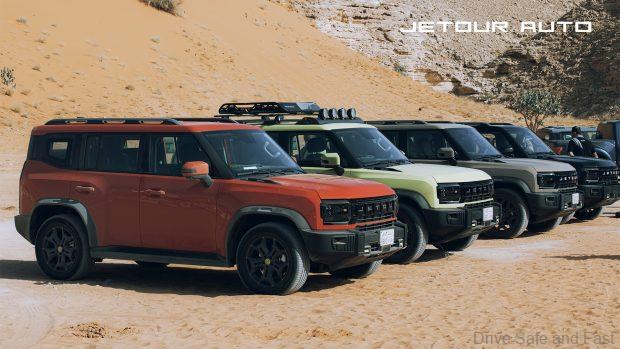
Dongfeng, Jetour, Chery, JAC, SAIC and BYD have been very succesful with electric, hybrid and even petrol powered models.
However, after the U.S. and Israel launched strikes on targets inside Iran, prompting Tehran to block the global oil trade’s “maritime chokepoint.” Satellite imagery shows vessels stranded near major ports like Fujairah in the UAE, while container carrier CMA CGM has ordered its ships in the Gulf to seek safe harbour which means, transportation of new vehicles into the region has halted.
China’s auto exports to the Middle East surpassed 1.25 million units in 2025 which is up more than 30 percent year-on-year with Saudi Arabia and the UAE absorbing 874,000 of those vehicles.

Yet even as widespread concern grips the market, Cui Dongshu, secretary-general of the China Passenger Car Association (CPCA), offers a seemingly counter-intuitive take: short-term disruptions won’t alter the broader upward trajectory of Chinese auto exports. In fact, the strategic value of the Middle East as a high-margin market is becoming even more pronounced.
Incidentially, its not just Chinese auto manufacturers who are affected. Toyota Motor Corp., Hyundai Motor Co. and Chinese automakers face mounting risks from a prolonged Iran conflict, with disrupted shipments and rising oil prices threatening to crash auto sales far beyond the Middle East, according to Bernstein equity research.
Global operations of international automakers show limited impact so far, but Asian brands have an outsized presence in the Middle East, according to the report by Berstein.
Toyota accounts for 17 percent of Middle East regional sales, Hyundai for 10 percent and Chery for 5 percent, according to Bernstein’s March 4 analysis. Inside Iran, Chinese players including Chery, Jianghuai, Hainan Automobile and Changan are the main international players.
Established global brands Toyota Motor Corp., Hyundai Motor Co. and Chinese automakers face mounting risks from a prolonged Iran conflict, with disrupted shipments and rising oil prices threatening to crash auto sales far beyond the Middle East, according to Bernstein equity research.
Global operations of international automakers show limited impact so far, but Asian brands have an outsized presence in the Middle East, according to the report by Berstein.
Toyota accounts for 17 percent of Middle East regional sales, Hyundai for 10 percent and Chery for 5 percent, according to Bernstein’s March 4 analysis. Inside Iran, Chinese players including Chery, Jianghuai, Hainan Automobile and Changan are the main international players.
Toyota Motor Corp., Hyundai Motor Co. and Chinese automakers face mounting risks from a prolonged Iran conflict, with disrupted shipments and rising oil prices threatening to crash auto sales far beyond the Middle East, according to Bernstein equity research.
Global operations of international automakers show limited impact so far, but Asian brands have an outsized presence in the Middle East, according to the report by Berstein.
Incidentially, not just Chinese auto manufacturers are affected by this war, Toyota accounts for 17 percent of Middle East regional sales, Hyundai for 10 percent and Chery for 5 percent, according to Bernstein’s March 4th 2026 analysis.
Meanwhile, in Iran, Chinese auto manufacturers like Chery, Jianghuai, Hainan Automobile and Changan are the main international players and they are also facing delivery issues.
Established global brands are mostly absent from Iran, due to sanctions. Still, Iran is the biggest automotive market in the region, accounting for about 38 percent of its 3 million sales last year.

