

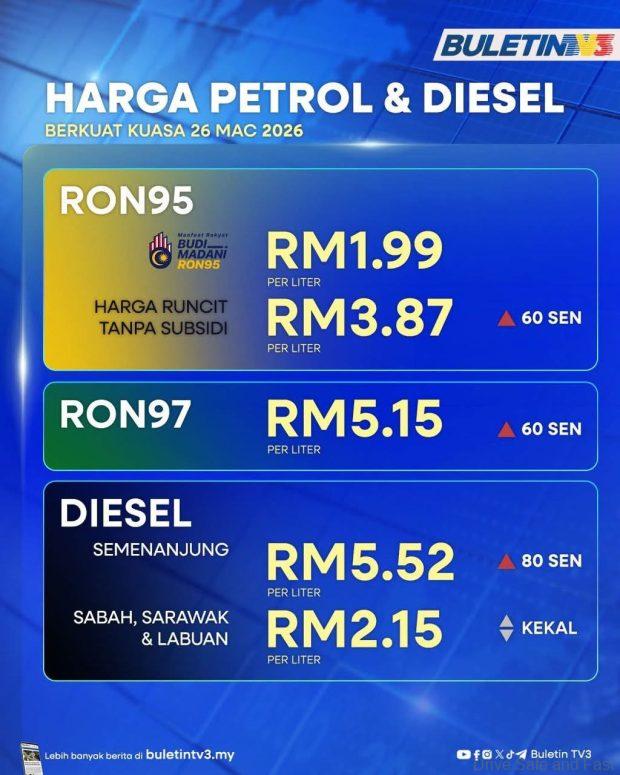
In a recent social media posts on the rising fuel prices in Malaysia due to the Middle East conflict, someone asked us why diesel prices in Sabah & Sarawak remain as before (high subsidy) and in Semenanjung Malaysia it is not the same?
Well, we never really thought about it and when we did some research this is what we found online.
In November 2023, way before any issue ….. this message was shared by www.pmo.gov.my. “The retargeting of the diesel subsidy in phases will only be carried out in the peninsula, Prime Minister Datuk Seri Anwar Ibrahim said.
Anwar, who is also Finance Minister, said the retargeting will not cover Sabah and Sarawak due to the comprehensive use of diesel in these states.
“(The retargeting of) diesel subsidy is only in the peninsula because diesel is used comprehensively in Sabah and Sarawak. Therefore, in order to implement it there, we would have to study the impact,” he said in winding up the debate on the Supply Bill 2024 at the policy stage in the Dewan Rakyat today.
Anwar said the total annual subsidy cost which has reached RM81 billion is also being enjoyed by foreign nationals and the rich.
“However, subsidised diesel for the fishermen will be continued (at RM1.65 per litre) while that for public transportation, including school buses and vans, remains at RM1.88 per litre.
“Therefore, I hope this retargeting of diesel subsidy can be accepted, as it is able to reduce the government’s (financial) burden,” he added.
The current price of subsidised diesel for the public is RM2.15 per litre compared to the market price that has hit RM3.78 per litre.”
So, the federal government maintains a full subsidy to ease high living costs in Borneo, as the region relies heavily on diesel for transportation, logistics, and power generation. This policy aims to protect residents from higher prices of goods.
Diesel is crucial in Sabah and Sarawak for transport (including 4×4 vehicles), logistics due to difficult terrain, and electricity generation in rural areas.
The government maintains the subsidy to prevent a surge in the cost of goods, as transportation costs for essential items are higher than in Peninsular Malaysia.
While Peninsular Malaysia faces reduced or targeted subsidies, Sabah and Sarawak were exempt from these changes to allow time to study the economic impact.
The federal government absorbs the significant difference between the market price and the subsidised pump price, spending billions annually to maintain the low rate.
And take note that the relative lack of infrastructure, including fewer roads, requires reliance on specific types of transportation (4×4 vehicles) that consume more diesel.

