


There is no single answer, and the reason why is the most useful thing an EV owner can learn.
Article by EVGuru.
Ask what public charging costs in Malaysia and you will get a range: somewhere between RM1.00 and RM2.20 per kWh. That is true, and it is useless.
The reason the range is so wide is that Malaysian charge point operators price by site, not by network. The same operator can charge you RM1.20 at one location and RM1.80 at another, twenty minutes down the same highway. So the useful question is not “which network is cheapest” but “what does the specific charger I am about to plug into cost, and how do I check before I drive there”.
Here is what the numbers actually look like, where they come from, and what it means for how you charge. EvGuru tracks these rates because customers ask us to justify the cost of a home charger against public charging, so the figures below come from published site reports, operator announcements and our own installation records.
1. One rest stop, five operators, an 83% spread
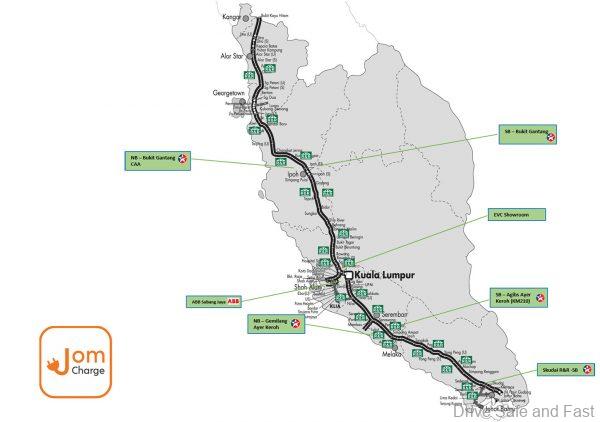
The clearest illustration of Malaysian charging pricing sits at Skudai R&R in Johor, a natural last top-up before Johor Bahru and the Causeway. Seven charging locations from five operators share one site.
These were the rates recorded there:
| Operator | Charger | Rate |
| JomCharge | DC | RM1.20 – RM1.30/kWh |
| Tesla Supercharger | 250 kW DC | RM1.19/kWh (Tesla vehicles only) |
| Charge+ | 120 kW DC | RM1.35/kWh |
| Shell Recharge | 120 kW DC | RM2.20/kWh |
| ChargEV | 17 kW AC | RM5.00 per 20 minutes |
Same car park. Same journey. Shell Recharge costs 83% more per kWh than JomCharge, sitting metres away. On a 40 kWh top-up that is RM88 against RM52 — a RM36 difference for parking in the wrong bay.
This is not an accusation of overcharging. Operators face different site rental, grid connection and hardware costs. But it does mean that brand loyalty to a charging app costs real money, and that the driver who checks two apps before pulling in is materially better off than the one who does not. This is the single most common thing EvGuru customers get wrong about public charging: they compare networks when the price is set per site.
2. Watch for time-based pricing
Look again at the ChargEV line above: RM5.00 per 20 minutes on a 17 kW AC charger. That is time-based pricing, and it behaves very differently from per-kWh.
What you pay depends entirely on how fast your car can accept AC power, not on how much energy you receive. EvGuru works this out for customers regularly, because the onboard AC limit is rarely on the spec sheet a buyer is shown:
| If your car accepts | Energy in 20 min | Effective cost |
| 17 kW AC (rare) | ~5.7 kWh | ~RM0.88/kWh |
| 11 kW AC | ~3.7 kWh | ~RM1.35/kWh |
| 7 kW AC (most common) | ~2.3 kWh | ~RM2.15/kWh |
| 3.6 kW AC | ~1.2 kWh | ~RM4.20/kWh |
A time-priced AC charger punishes the slower car. If your EV tops out at 7 kW on AC — which covers most models sold here — a time-based AC charger can cost more per kWh than DC fast charging. Check whether a charger is priced per kWh or per minute before plugging in.
The same trap exists in reverse on DC. Reported time-priced DC chargers in Sarawak worked out anywhere from RM0.42/kWh to RM3.20/kWh depending on how fast the car could actually pull, on identical hardware, before those sites were repriced in March 2026.
3. Where the major networks sit
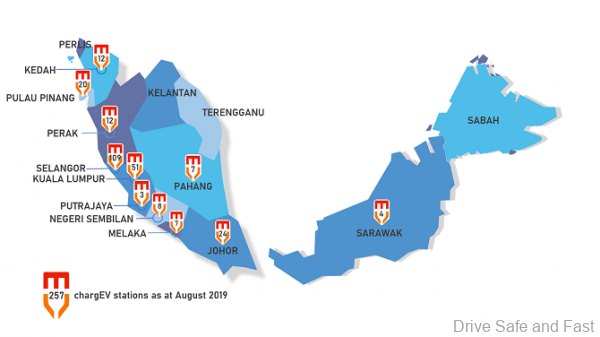
With the caveat that everything is site-specific, this is the broad shape of the market as of mid-2026.
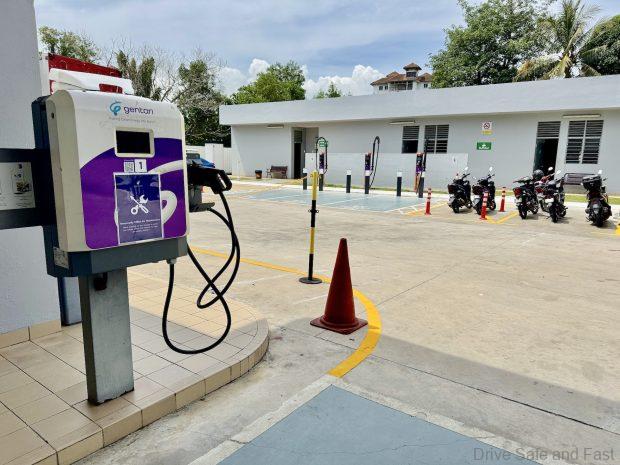
Gentari (Petronas)
Since the March 2025 revision, Gentari prices DC by location type rather than charger power:
| Site type | Rate |
| Destination sites | RM1.60/kWh |
| Interstate highway sites | RM1.70/kWh |
| Battery-storage (BESS) sites | RM1.80/kWh |
| Selected sites, cut July 2026 | from RM1.30/kWh |
- Price cut, 15 July 2026 — selected DC sites across the Klang Valley, Perak, Penang, Terengganu and Pahang came down to a floor of RM1.30/kWh. The full list is in the Gentari Go app, and the new rates carry across to roaming partners.
- Subscriptions — Go Starter at RM350/year for 15% off, Go Plus at RM699/year for 30% off. At 30% off, an RM1.60/kWh site becomes RM1.12/kWh. Worth the maths if you use DC regularly.
- Off-peak trial — RM1.36/kWh between midnight and 06:59 was trialled at selected sites from 30 April 2026. Check whether it still applies at yours.
- AutoCharge — opened to all Gentari Go users from 1 July 2026, previously subscribers only.
JomCharge (EV Connection)
The largest CCS2 footprint nationwide. Broadly around RM1.40/kWh for DC and RM1.10/kWh for AC, but genuinely site-dependent — Skudai R&R came down to RM1.20–1.30/kWh in a 2025 revision.
Others
- Shell Recharge — priced at the top of the market at the site above, RM2.20/kWh.
- ChargEV (Yinson GreenTech) — discontinued its annual subscription on 31 October 2024, now pay-per-use. A mix of per-kWh and time-based sites.
- Tesla Supercharger — four Klang Valley sites opened to non-Tesla CCS2 cars on 3 March 2026 (i-City Shah Alam, Pavilion KL, IOI City Mall Putrajaya, Gamuda Cove). RM1.80/kWh for non-members, roughly RM0.99–1.08/kWh with Tesla membership, plus a congestion fee of up to RM2.00/min when busy.
- Smaller operators are often cheaper — DC Handal has run selected DC sites at RM1.00/kWh, and Kuro EV has promoted DC as low as RM0.88/kWh. These are usually accessible through the JomCharge or ChargEV apps.
A note on roaming fees. Using one operator’s charger through another operator’s app can add a surcharge. Gentari Go, for example, has applied a 6% roaming fee on DC Handal chargers, turning RM1.50/kWh into RM1.59/kWh. Same charger, same session, different app.
4. Idle and overstay fees are now normal
Leaving a car plugged in after it has finished charging now costs money on most networks. This is deliberate: a fully charged car occupying a DC bay is the main cause of queues.
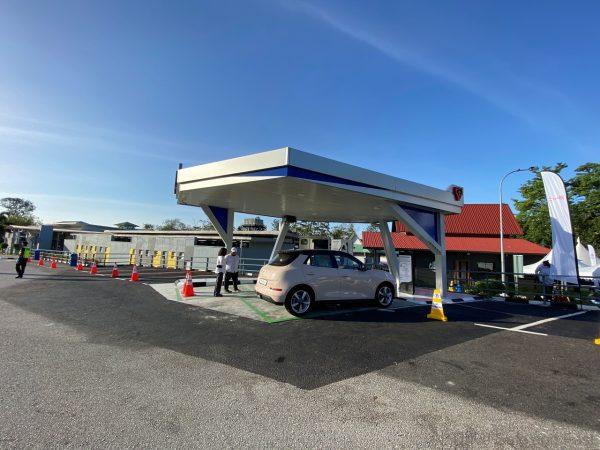
Reported charges vary by site and operator, and one example gives a sense of scale: a Gentari 200 kW DC charger at Petronas Penchala Link applies an overstay fee of RM1.50 per minute after one hour connected — RM90 an hour.
Idle fee structures differ by operator and by site, and none of the major networks publishes a single clear nationwide schedule. Check the fee terms on the charger screen or in the app before you walk away from the car.
5. Now compare that with charging at home
This is where the numbers stop being close.
Since the 1 July 2025 tariff restructure, domestic electricity is built from separate components rather than the old tiered blocks. For households using up to 1,500 kWh a month, energy, capacity and network components total roughly 44.43 sen/kWh, before the monthly AFA adjustment.
Domestic customers can also opt into a Time of Use tariff, which drops the rate substantially during off-peak hours. For overnight charging, that is the relevant number. The comparison below is the one EvGuru puts in front of customers deciding whether a home charger is worth the outlay.
| How you charge | Effective cost | Cost of a 40 kWh top-up |
| Home, ToU off-peak | ~24 sen/kWh | ~RM10 |
| Home, standard domestic | ~44 sen/kWh | ~RM18 |
| Public DC, cheapest sites | RM1.00 – RM1.30/kWh | RM40 – RM52 |
| Public DC, typical | RM1.60 – RM1.80/kWh | RM64 – RM72 |
| Public DC, most expensive | RM2.20/kWh | RM88 |
Public DC fast charging costs roughly four to nine times more per kWh than charging at home overnight on the off-peak tariff. That gap is the whole economic case for a home charger.
The threshold that catches new EV owners out
Across EvGuru installation records, an EV typically adds 150 – 350 kWh a month to a household. That is enough to cross two thresholds at once:
- Past 600 kWh — the RM10 retail charge applies, and service tax begins on consumption above that level
- Past 1,000 kWh — the Energy Efficiency Incentive rebate is lost entirely
So the first bill after the car arrives can rise by more than the charging itself. Nothing has gone wrong; the household has simply moved out of the band that was shielding it. Switching to ToU and scheduling the charger to start after midnight is the direct fix, and most smart chargers will do it automatically once set.
ToU carries a higher peak rate in exchange for the cheaper off-peak window. If someone is home during the day running air conditioning, run the numbers on your own usage before switching. It is not automatically better for every household.
6. What this means in practice
| Situation | What actually makes sense |
| Daily commuting | Home charging overnight on ToU. Public charging as a daily habit costs several hundred ringgit a month more. |
| Road trips | Public DC, but check the app for the specific site. Two operators at the same rest stop can differ by 80%. |
| Heavy DC user | A network subscription changes the maths. 30% off RM1.60/kWh is RM1.12/kWh. |
| Condominium, no home charger | Public charging is the expensive default. A shared or private charger in the building is worth pushing for. |
| Slow AC car (7 kW) | Avoid time-based AC chargers. You pay for minutes, not energy. |
7. If you are pricing chargers for a building
For property managers and JMB committees, the picture inverts: public charging pricing is what makes an in-building charger attractive to residents, and what makes it viable as a service.
From EvGuru installation and commissioning work across Peninsular Malaysia:
| Setup | Indicative cost | Notes |
| Home AC charger, landed | Installation from RM1,590 | Single-phase 7.4 kW, ST-registered, SIRIM-certified materials |
| One AC charger, commercial | From about RM5,000 | Includes cabling, protection and CMS setup |
| DC fast charging project | From about RM40,000 | 60 kW to 240 kW, suits malls, highway stops and fleet depots |
| Practical charger ratio | 1 per 30–50 bays | Starting point for commercial car parks, adjusted after a load assessment |
The one-charger-per-30-to-50-bays figure is where EvGuru starts a commercial quote; the final number comes out of the load assessment, not the bay count. Two points that matter more than the hardware cost:
- Load management usually beats a supply upgrade. Multiple chargers sharing available power avoids the cost and delay of increasing the building’s incoming capacity.
- Public-use chargers need an EVCS licence from Suruhanjaya Tenaga under the Electricity Supply Act, whether or not you charge for the electricity. Installations must also meet the ST guidelines for EV charging systems (GP/ST/No. 54/2025).
Buildings that set their own kWh rate keep the margin between what residents pay and the actual electricity cost, which is what turns a resident amenity into something that pays for itself.
The short version
- Public charging in Malaysia runs roughly RM0.88 to RM2.20 per kWh, priced by site rather than by network.
- Check the app before you drive. At one rest stop the spread between operators was 83%.
- Per-kWh is predictable; per-minute is not. Time-based AC pricing punishes cars with slower onboard chargers.
- Home charging on ToU costs roughly a quarter of public DC. For daily driving, that gap is the entire argument.
- Expect an idle fee. Move the car when it is done.
Rates in this article are drawn from published site reports and operator announcements up to July 2026, and are noted with their source where specific. Malaysian charging prices change frequently and vary by location — always confirm in the relevant app before charging. Issac Neng runs EvGuru, an EV charger supplier and installer operating across Peninsular Malaysia since 2021, with commercial installations including TNB, Menara Ilham, Sri Hartamas Shopping Centre and Four Seasons Place. More at evguru.com.my.

