


I revisit the Honda HR-V e:HEV, this time in facelift form.
I had a chance this weekend to re-experience the Honda HR-V e:HEV RS. I say re-experience, but to be honest, the last time I drove this car was in 2022 in its original form. The version I took for Labour Day weekend was the facelift, which sports some minor but meaningful changes. The HR-V e:HEV has something of a soft spot for me, as it was the vehicle I used to transport my parents and grandmother to KL for my wedding. Along with the older folks, it also managed to fit a large cooler box and tonnes of other supplies and luggage for 4 people. I don’t have many photos of that particular trip, but I certainly still have the memories.

Re-experiencing the HR-V e:HEV nearly 4 years later, I have to say that the car’s strengths and weaknesses are still somewhat unchanged. It’s a really respectable vehicle that still appeals to a wide demographic. Singles and those who probably find themselves driving solo 99% of the time would be better suited to a WR-V or either of the two City variants. Those with large families or who are looking to uphold a higher ‘status’ amongst their peers or employees might opt for the CR-V instead.
Anyone looking for a more dynamic drive will probably find themselves attracted to the Civic instead. Each of the models named, save the WR-V, is available in petrol and hybrid form too. So how is it the HR-V manages to find such a large and diverse crowd of customers still?

Well, it’s because the HR-V is the one model that represents Honda Malaysia’s overall strategy best. No other model in their line-up is offered with 3 completely different powertrain options. 4 if you count the e:N1 as an extensively re-engineered-for-electric HR-V.

It also combined the flexible ULTRA seats and unmatched interior packaging of their compact City model with a larger and more utilitarian crossover body style. Plus, I also think it looks the most upmarket and futuristic of the current Honda range.

I don’t think most people realist just how much utility is unlocked by the ULTRA seats. Flipping up the seat bench is useful for moving large potted plants and certain types of furniture.

However, the magic is also there when you fold the seat back down too because it collapses the bench and that gives you a nice even expanded boot floor.

Speaking of the boot, there’s another unique Honda feature related to it – Walk-Away Close. Instead of waving your foot around with your hands full, you can click this button, pick up your items, then just walk away. The tailgate will shut and all doors will lock automatically. It’s thoughtful and practical.

Within the cabin, the air diffusion vents are also another nice touch for this generation of HR-V. This channels air away from both the driver and windows, so you still get the cabin cooling effect but without the discomfort or misting.

Finally, there’s also LaneWatch, and this is quite possibly the last time we’ll see it on the HR-V. The latest CR-V facelift brings blind spot monitoring instead and some on the internet have now voiced that they actually miss having that camera around. To be honest, I do like LaneWatch too, but I usually set it to only trigger manually as I don’t always want or need it to take up my entire infotainment display.

My hope is that Honda improves the camera module and moves the output to the digital instrument cluster instead.

And yes, it would be excellent if they could offer this hypothetically improved LaneWatch alongside BSM. Oh and a 360-degree camera would be nice too in 2026.

Despite all the unique and practical features, this generation of HR-V is actually a hair smaller than the last one in terms of boots space and rear passenger room.

That being said, you still get amenities like an arm rest and rear air cond blowers plus two USB-C ports for charging.

The new Phoenix Orange Pearl paint option is really eye-catching and helps to bring some new life into the design. The HR-V remains one of the cleanest looking Japanese SUVs on the market. Rivals in this space feel one generation behind on design trends even if they’re slightly larger.

The only thing Honda changed was the front grille and bumper and I think the new RS face looks a little nicer overall.

That being said, I’m still not a fan of the little red heart beat cardiogram graphic on the lower grille. It’s the one element of the exterior design I would have deleted for the facelift.

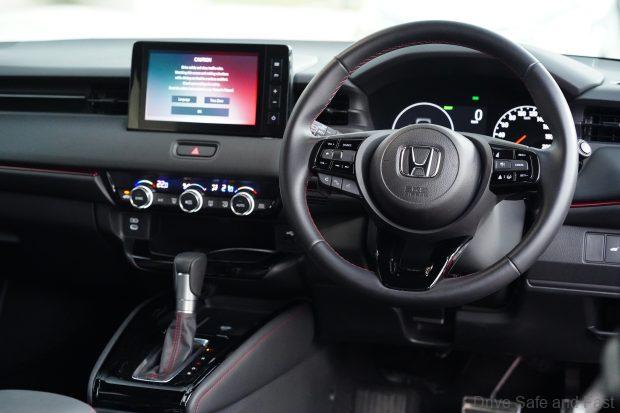
Inside, the RS trim shines here with nice leather, red stitching and ‘RS’ embossed seats’ alongside red trim pieces.


The steering wheel’s also one of the most upmarket feeling ones you’ll find at this price point and you’ve got paddle shifters to adjust brake regen levels on the fly, which many EVs and Hybrids still don’t allow you to do. The semi-digital instrument cluster is really good too with deep blacks and smooth animations.

Honda Malaysia has always been really good at delivering good safety equipment levels and the HR-V continues this tradition with Level 2 ADAS features and 6 airbags on this variant.


I can’t finish this review off without talking about the hybrid system even though I have extensively explained it in the past. e:HEV is an evolution of Honda’s i-MMD system. Honda has experimented with a few different hybrid configurations before settling on this one for its best overall balance. Essentially the wheels are moved by an electric motor for a majority of start-stop driving while the petrol engine kicks in to recharge the battery. Only when you’re cruising at medium-to-high speed, the petrol engine comes in to directly drive the wheels.

When heavy acceleration is called for, it’s actually back to electric drive but with the petrol engine revving high to ensure the battery is able to output high amounts of power. Models like the HR-V and City use a 1.5L for the e:HEV system. In my experience, the 2.0L version in the Civic and CR-V is far superior in terms of output and smoothness but this version is more fuel efficient overall. If you treat want to extract some serious range from a petrol crossover, you can’t go wrong with the Honda HR-V e:HEV. Just keep a light foot and the system will sort itself out. It really is as simple as that.


Behind the wheel, the HR-V’s offers great feedback and very competent handling. It’s perhaps not as fun as the turbo model, but still has plenty of shove. Suspension is perhaps a little on the firmer side and doesn’t quite float over speed bumps but does a decent enough job at providing a comfortable daily experience. I’d say for a vast majority of drivers, the HR-V e:HEV ticks more boxes than its competition, only meaningfully losing out when it comes to rear passenger comfort.
That being said there’s still room for improvement. NVH at speeds above 80km/h is nothing to write home about. It might be down to the factory tyre choice, but I’m not entirely sure. Addressing this area and improving the cameras would put the HR-V e:HEV back at the tippy top of crossovers in this segment, but again there’s no running away from size and price factors. There’s always going to be a Chinese brand with a larger and more aggressively price product.

Still, if you’re a conservative buyer looking for an upmarket feeling fuel-saver that’s not too large but still more versatile and practical, the HR-V e:HEV’s an excellent choice.
2025 Honda HR-V e:HEV Specifications
Engine: 4 Cylinder, 16 Valve, DOHC (Atkinson Cycle)
Capacity: 1498cc
Gearbox: eCVT
Max power (petrol): 105PS @ 6000rpm
Max power (electric): 129PS
Max torque (petrol): 131Nm @ 4500rpm
Max torque (electric): 253Nm
Top Speed: 200 km/h
0-100 km/h: 8.8 seconds
Price: RM143,900

