


Until recently, GM pinned its hopes on Ultium-based models to compete in the highly competitive China EV market. But, as Ford, Volkswagen, and others (Tesla aside) have found, foreign-developed EV platforms have failed to gain traction in China.
In 2024, GM abandoned its Ultium project altogether. Honda has been more localised, developing its China-specific Ye Series (Pictured below).
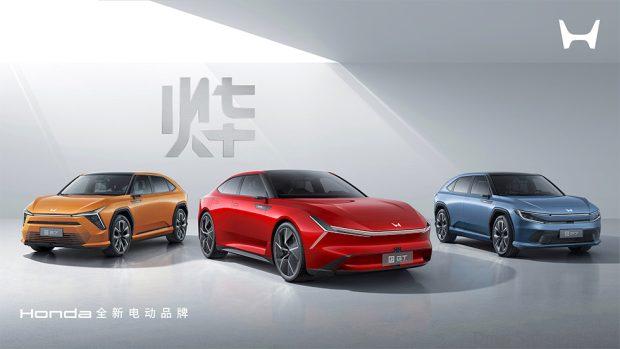
While both companies are retrofitting plants or adding some NEV capacity, they have avoided the large-scale R&D spending and headline partnerships such as the VW-Xpeng (Volkswagen and Xpeng have established a strategic partnership to develop software, electronics, and electric vehicles for the Chinese market. The collaboration leverages Volkswagen’s scale with Xpeng’s autonomous driving and AI-chip expertise, cutting vehicle development times by up to 30 percent) or the Toyota-BYD (Toyota and BYD formed a 50/50 joint venture, BYD Toyota EV Technology Co. Ltd. (BTET), in 2020 to develop Battery Electric Vehicles (BEVs). The partnership combines Toyota’s global engineering and quality control with BYD’s cost-effective electric powertrain and LFP Blade battery technologies)
But with JV losses mounting, pressure is building for the undecided to pick a lane: double down with greater local investment, expand partnerships, sell assets, or pivot more decisively toward exports.
How foreign legacy carmakers restructure their China operations will shape not only their own individual fortunes, but also carry wider consequences for the sector. At home, they remain among the largest employers and R&D investors, meaning a profit downturn or a shift in production and R&D could have major domestic impacts.
Meanwhile, in China, their SOE partners often rely on them as their main source of profitability. And globally, suppliers that followed them into the China market are deeply exposed to changes in strategy of foreign OEMs.
Are European And American Auto Suppliers Still Relevant
Most foreign suppliers followed their OEM clients into China. As foreign carmakers lost market share, many suppliers tried to diversify their revenue sources by serving more Chinese OEMs.
Strong overall auto production, buoyed by exports, has masked the impact of weaker demand from foreign OEMs, but risks are mounting. Chinese carmakers are pushing harder on costs, demanding frequent price cuts, renegotiations, and longer payment terms which erodes margins and creates cash flow problems not only for Chinese suppliers but also for foreign ones.
Despite an overall growing market, German supplier Schaeffler reported a 3.8% revenue decline in China from 2023 to 2024, citing “structural changes and reduced demand from foreign automobile manufacturer customers.”
Smaller firms, as well as those tied closely to individual OEMs, are most exposed. Hyundai Mobis, for example, saw its China revenues fall by USD$6 billion over the past decade which is a 80% drop due to its dependence on Hyundai and Kia. Japan’s Nippon Steel has decided to end its two-decade contract with Baosteel, reflecting lower output from its main Japanese OEM customers in China.
These trends mirror the strategic choices of foreign OEMs. As some exit or downsize, their suppliers face shrinking demand and stranded capacity. The export pivot of foreign OEMs may offer some suppliers a temporary lifeline, but only if they are integrated into those supply chains.
For suppliers to the double downers, the pressure to localize R&D and technology partnerships risks reducing the role of traditional foreign suppliers altogether. And for the undecided, prolonged hesitation deepens uncertainty for their supplier networks.
In short, the fortunes of foreign suppliers are directly tied to the diverging paths of their OEM clients, making the ongoing shakeout in China’s auto sector just as existential for them.

