


Following a five-year hiatus, Mitsubishi Motors Corporation has officially revived one of the automotive world’s most celebrated badges with the world premiere of the all-new Mitsubishi Pajero in Tokyo.
When I first read that the Pajero was returning, my first fear was that it would be a successor to the Pajero Sport and positioned to fight off the Toyota Fortuner. The fact that it was built on the same bones as the new Triton and was meant to be manufactured in Thailand solidified those fears further. However, now that I’ve done a little more research, I’m satisfied that Mitsubishi has not built an ordinary pickup-derived runabout. Instead, the Japanese marque has engineered a heavy-duty, high-prestige flagship specifically conceived to go toe-to-toe with the Toyota Land Cruiser Prado (250 Series), some thing Toyota has refused to do for ASEAN.
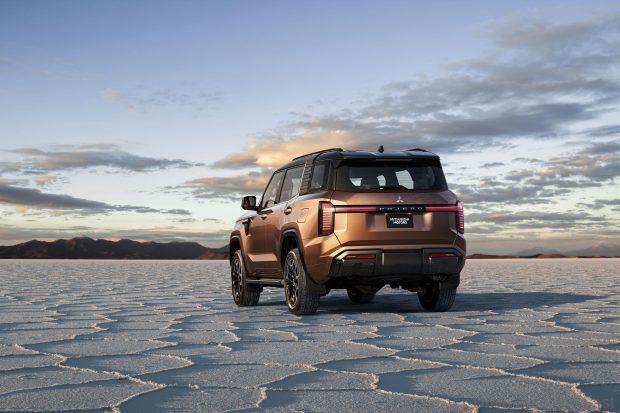
Built at Mitsubishi’s manufacturing hub in Thailand, the all-new Pajero will debut in Thailand first, followed by rollouts in Japan and Australia within fiscal year 2026, before expanding across ASEAN and other global markets from 2027 onward. For Malaysian buyers who have long awaited the return of a genuine, full-size Japanese cross-country flagship, this reimagined Pajero delivers true heavyweight credentials.

Full-Size Proportions That Dwarf Traditional B-Segment and PPV SUVs
The clearest proof of the new Pajero’s upmarket repositioning lies in its massive physical footprint. Rather than adhering to the narrow dimensions typical of midsize ladder-frame contenders like the Toyota Fortuner, the all-new Pajero claims full-size road presence:
- Length: 4,920 mm, matching the Land Cruiser Prado (4,925 mm) and exceeding the Fortuner by a massive 125 mm.
- Width: 1,925 mm, providing broad, planted shoulders compared to the Fortuner’s 1,855 mm.
- Height: 1,910 mm, delivering commanding, upright visibility.
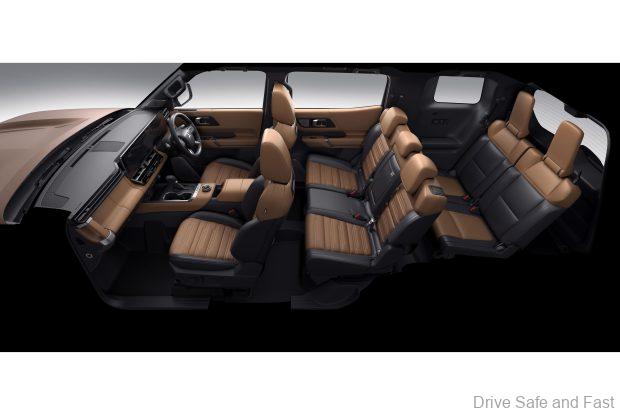
- Wheelbase: 2,870 mm, which is not only 125 mm longer than the Fortuner, but actually stretches 20 mm longer than the Land Cruiser Prado 250’s wheelbase (2,850 mm), translating into unmatched cabin volume across all three seating rows.

Its off-road geometry reinforces authentic cross-country superiority: 230 mm of ground clearance, a 30.4-degree approach angle, a 22.6-degree ramp breakover angle, and a 25.8-degree departure angle, backed by an optimized 52:48 front-to-rear weight balance.
Driveline Sophistication: Super Select 4WD-II and Dakar-Bred S-AWC
Where budget-oriented SUVs rely on rudimentary part-time 4WD setups that can only be engaged on loose dirt, the all-new Pajero incorporates driveline sophistication that matches and out-thinks high-end overland hardware:
- Permanent 4WD Capability: The Super Select 4WD-II (SS4-II) system features a full-time 4H mode with an unlocked center differential. This allows full-time all-wheel drive stability on dry highway tarmac and slippery wet asphalt alike—a crucial safety and stability feature shared with the Prado that part-time systems simply cannot offer.
- True Extreme-Terrain Gearing: Shifting into 4HLc locks the center differential for sand and gravel, while 4LLc engages low-range crawl gears for technical ascents.
- Super-All Wheel Control (S-AWC): Mitsubishi layers its rally-proven S-AWC architecture, integrating Active Yaw Control (AYC) brake-vectoring, Active Stability and Traction Control (ASTC), and specialized ABS to actively distribute torque side-to-side.
- Seven Multi-Terrain Modes: Normal, Eco, Gravel, Snow, Mud, Sand, and Rock modes dynamically adapt engine mapping, transmission shift points, and brake vectoring.
Clean Diesel Muscle and Seamless 8-Speed Gearing
Under the sculpted hood sits a specially developed 2.4-litre clean diesel engine equipped with a wide-range variable geometry turbocharger (VGT). Developing a stout 480 Nm of torque (470 Nm on select variants), the powerplant delivers linear low-end grunt tailored for heavy towing and rock crawling.
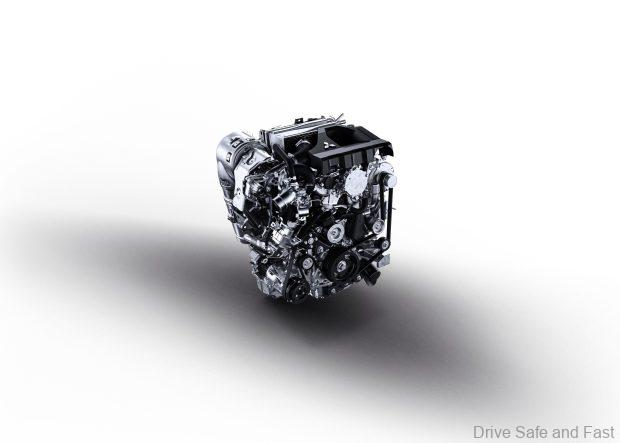
Crucially, the engine is paired with a newly developed 8-speed automatic transmission with manual sport mode. Moving up to an 8-speed unit provides the close-ratio refinement and tall highway overdrive gears expected of a luxury cruiser, placing it on par with modern Land Cruiser gearboxes while avoiding the coarser shifting behaviors of legacy 6-speed commercial transmissions.
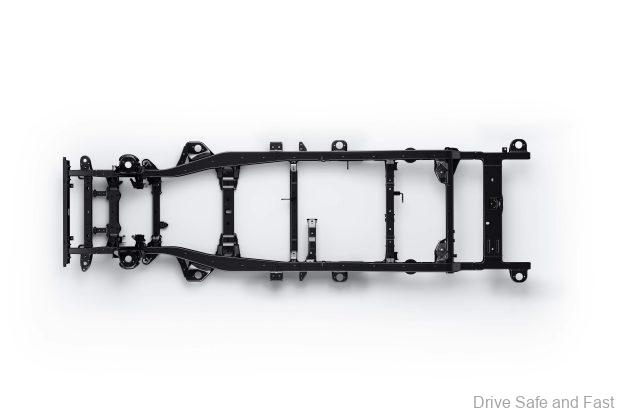
Underneath, high-tensile steel reinforcements significantly boost the ladder frame’s torsional rigidity, supported by an independent double-wishbone front suspension and a newly engineered five-link rigid rear axle. Specialized decoupled body mounts actively isolate frame vibrations, achieving the smooth ride refinement necessary to challenge premium monocoque and luxury frame-based contenders alike.
Executive Cabin Luxury: Craftsmanship Worthy of a Flagship
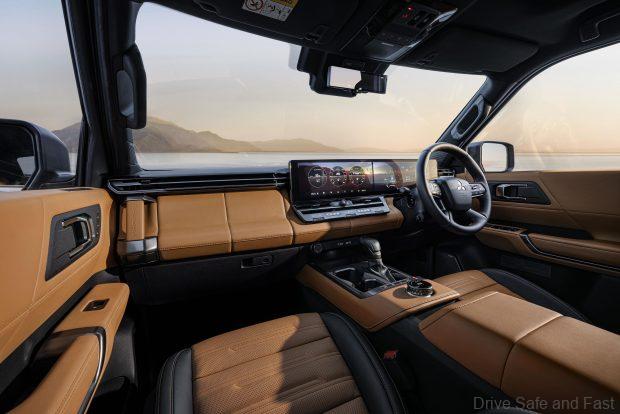
Step inside, and the all-new Pajero leaves utilitarian commercial cabins far behind. Guided by its “Grand Charisma” design ethos, the interior presents an executive sanctuary:
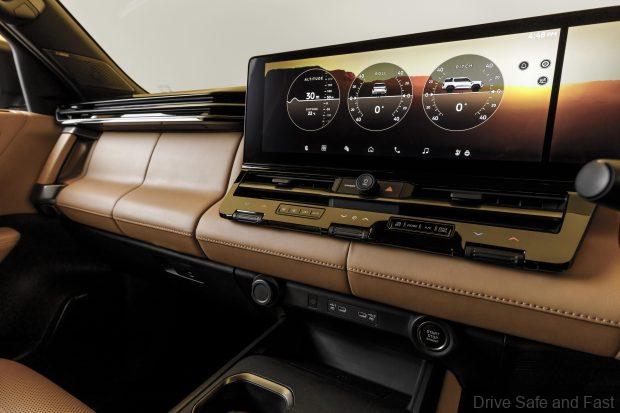
- Monolithic Glass Cockpit: A seamless dashboard houses dual 14.3-inch ultra-high-definition displays (12.3-inch on select trims) with 16 dynamic time-of-day themes. The iconic dashboard triple-gauge cluster is reborn digitally as the Multi-Meter, displaying real-time pitch, roll, compass bearings, altitude, and AYC vectoring telemetry.
- Artisanal Japanese Detailing: Upholstered in soft-touch Camel and black leather featuring traditional Kimekomi-inspired stitching, accented by three-zone automatic climate control, full-seat ventilation across the front and middle rows, and acoustic laminated glass on the windshield and side windows.
- Audiophile Acoustics: A bespoke 12-speaker Dynamic Sound Yamaha Ultimate sound system with dual amplifiers incorporates active vehicle-speed noise compensation algorithms to maintain acoustic clarity over rough surfaces.
Next-Level Safety: MI-PILOT and Transparent Under-Floor Cameras
Safety technology is comprehensive, anchored by MI-PILOT highway driving assistance with Adaptive Cruise Control (ACC) and Lane Keep Assist (LKA).
The active safety suite also debuts Emergency Lane Assist (ELA), Front Cross Traffic Alert (FCTA), Forward Collision Mitigation (FCM) with junction turning detection, and an innovative SRS center airbag within an eight-airbag protective shield.
For technical off-roading, the 3D Multi Around Monitor projects a real-time, transparent front under-floor camera view at 30 frames per second. Automatically activating in 4HLc and 4LLc modes, it enables drivers to “see through” the engine bay to navigate around hidden boulders and treacherous ruts with complete confidence.
A True Land Cruiser Alternative for the Discerning Enthusiast
With production anchored in Thailand, the all-new Mitsubishi Pajero combines high-end Japanese engineering with duty-efficient regional assembly. It boasts the imposing dimensions of an executive tourer, full-time four-wheel-drive sophistication, an 8-speed clean diesel powertrain, and a cabin that rivals luxury overland flagships.
Far from being just another commercial utility replacement, the all-new Pajero re-establishes itself in its rightful place: a genuine, world-class contender ready to challenge the Toyota Land Cruiser Prado at every turn.

